GCSE Chemistry Revision Notes PDF: A Comprehensive Plan
As the CBSE Class 12 Chemistry exam nears (05/04/2026 12:55:21)‚ focused last-minute revision using PDF notes is crucial for student success and confidence.
Embarking on GCSE Chemistry revision? Utilizing readily available resources‚ particularly PDF revision notes‚ is a smart strategy. With the CBSE Class 12 Chemistry exam looming on 05/04/2026‚ students are prioritizing focused review.
These PDFs consolidate key concepts‚ offering a portable and accessible study aid. They complement textbooks and class notes‚ providing targeted practice and reinforcing understanding. Effective revision isn’t just about re-reading; it’s about active recall and applying knowledge – PDFs can facilitate this!
Understanding the GCSE Chemistry Exam Format
Knowing the exam structure is vital for effective revision‚ especially with the CBSE Class 12 Chemistry exam approaching on 05/04/2026. GCSE Chemistry exams typically include multiple-choice‚ calculations‚ and practical application questions.
PDF revision notes should align with this format‚ offering practice questions mirroring the exam style. Understanding weighting of topics allows focused study. Familiarity reduces exam anxiety and maximizes performance‚ making targeted PDF use incredibly beneficial.
Paper 1: Paper 2: Combined Science vs. Separate Science
Students preparing for the 05/04/2026 Chemistry exam must know their pathway. Combined Science covers core concepts‚ while Separate Science delves deeper. PDF revision notes should be tailored accordingly.
Combined Science PDFs focus on fundamental principles‚ while Separate Science notes include advanced topics and detailed explanations. Recognizing the exam paper structure – Paper 1 & 2 – allows students to prioritize relevant content within their chosen PDF resources for optimal revision.
Question Types: Multiple Choice‚ Calculations‚ Practical Questions
Effective revision‚ especially nearing 05/04/2026‚ requires targeted practice. GCSE Chemistry PDFs should include varied question types: multiple choice for quick recall‚ calculations to build problem-solving skills‚ and practical questions to assess experimental understanding.
Prioritize PDFs with worked examples and answer explanations. Focus on areas where students struggle‚ utilizing the notes to reinforce concepts and improve exam technique across all question formats.
Key Topics in GCSE Chemistry – An Overview
With the exam approaching on 05/04/2026‚ comprehensive GCSE Chemistry revision PDFs must cover core topics. These include atomic structure‚ bonding‚ rates of reaction‚ quantitative chemistry‚ organic chemistry‚ and chemical analysis.
PDFs should provide concise summaries and key definitions for each area. Prioritize resources that link these topics‚ demonstrating a holistic understanding of chemical principles‚ aiding focused last-minute preparation.
Atomic Structure and the Periodic Table
Effective revision PDFs (crucial before 05/04/2026) should clearly explain atomic number‚ mass number‚ and isotopes. They must detail electronic configuration and its link to the periodic table’s group trends.
Focus on understanding how electron arrangement dictates an element’s reactivity. Diagrams illustrating shell filling and periodic trends are essential for quick recall during focused‚ last-minute study sessions.
Atomic Number‚ Mass Number‚ Isotopes
Prior to the exam (05/04/2026)‚ revision PDFs must define atomic number as proton count and mass number as proton + neutron total. Isotope explanations should highlight variations in neutron numbers‚ impacting atomic mass.
Practice calculating relative atomic mass from isotope abundance data. Understanding these concepts is fundamental; clear diagrams within PDFs aid quick comprehension during intense‚ final revision periods.
Electronic Configuration & Group Trends
With the exam approaching (05/04/2026)‚ revision PDFs should clearly demonstrate writing electronic configurations using 2‚8‚8 rule. Focus on relating configuration to group number – determining reactivity.
Group trend explanations (atomic radius‚ ionization energy) are vital. PDFs should include diagrams illustrating these trends. Mastering these concepts‚ alongside practice questions‚ will boost exam performance and confidence.
Bonding‚ Structure and Properties of Matter
Considering the looming exam (05/04/2026)‚ revision PDFs must thoroughly cover ionic‚ covalent‚ and metallic bonding. Diagrams illustrating lattice structures and electron sharing are essential.
Relate bonding type to physical properties – melting/boiling points‚ conductivity‚ and solubility. Practice predicting properties based on structure. Strong understanding of these concepts is key for success.
Ionic Bonding: Properties & Examples
With the exam approaching (05/04/2026)‚ revision PDFs should detail how ions form through electron transfer‚ creating strong electrostatic forces. Focus on lattice structures and high melting/boiling points.
Examples like sodium chloride (NaCl) are vital. Explain conductivity in molten/solution states‚ but not solid. Practice drawing dot-and-cross diagrams to visualize electron transfer. Solid foundation is crucial.
Covalent Bonding: Properties & Examples

Considering the looming exam (05/04/2026)‚ revision PDFs must clarify covalent bonding – sharing electrons. Emphasize lower melting/boiling points compared to ionic compounds‚ and poor conductivity.
Illustrate with examples like methane (CH4) and water (H2O). Explain single‚ double‚ and triple bonds. Dot-and-cross diagrams are essential for visualizing shared electron pairs. Understand the concept of molecular structures.
Metallic Bonding: Properties & Examples
With the exam approaching (05/04/2026)‚ revision PDFs should detail metallic bonding – a ‘sea’ of delocalized electrons. Highlight excellent conductivity (heat & electricity)‚ malleability‚ and ductility.
Examples include copper (Cu)‚ iron (Fe)‚ and aluminum (Al). Explain how delocalized electrons allow layers to slide‚ contributing to malleability. Strong metallic bonds result in high melting/boiling points. Focus on the structure and its relation to properties.
Chemical Reactions – Types and Rates
Considering the looming exam (05/04/2026)‚ revision PDFs must cover reaction types: synthesis‚ decomposition‚ single/double displacement‚ and combustion. Emphasize rate factors – concentration‚ temperature‚ surface area‚ and catalysts.
Explain how increasing these factors generally speeds up reactions. Include collision theory as a core concept. Students should practice identifying reaction types and predicting rate changes. Effective revision focuses on understanding why rates change‚ not just that they do.
Acid-Base Reactions: Neutralisation‚ Titration
With the exam approaching (05/04/2026)‚ revision PDFs should thoroughly explain neutralisation reactions – acid + base → salt + water. Focus on the pH scale and identifying acids/bases.
Titration is key; students need to understand calculations involving moles‚ concentration‚ and volumes. Practice problems are vital. Emphasize the importance of accurate measurements and indicator selection for endpoint determination. Understanding these concepts builds a strong foundation.
Redox Reactions: Oxidation & Reduction
Considering the looming exam (05/04/2026)‚ revision PDFs must clearly define oxidation (loss of electrons) and reduction (gain of electrons). Mnemonics like “OIL RIG” are helpful for recall.
Students should practice identifying redox reactions and assigning oxidation numbers. Understanding half-equations is crucial for balancing redox equations; Focus on real-world applications like corrosion and batteries. Mastering these concepts is essential for exam success and deeper understanding.
Factors Affecting Reaction Rate: Concentration‚ Temperature‚ Surface Area‚ Catalysts
With the exam approaching (05/04/2026)‚ revision PDFs should emphasize how increasing concentration or temperature boosts reaction rates due to more frequent collisions.
Greater surface area also accelerates reactions‚ while catalysts provide alternative pathways with lower activation energy; Students need to understand these factors’ impact and explain them using collision theory. Practice applying these concepts to practical scenarios for effective exam preparation.

Quantitative Chemistry – Calculations
Considering the looming exam (05/04/2026)‚ GCSE revision PDFs must prioritize mastering quantitative chemistry calculations. Focus on relative formula mass (Mr) and the mole concept as foundational elements.
Students should practice stoichiometry and identifying limiting reactants through worked examples. Thorough understanding of these calculations is vital for success‚ especially given the time constraints during revision‚ ensuring confident problem-solving skills.
Relative Formula Mass (Mr) & Mole Concept
With the exam approaching (05/04/2026)‚ GCSE chemistry revision PDFs should heavily emphasize relative formula mass (Mr) calculations and the mole concept. These are fundamental to quantitative chemistry.
Students need to practice determining Mr from chemical formulas and converting between mass‚ moles‚ and number of particles. Mastering these concepts is crucial for tackling more complex stoichiometric problems efficiently during the exam.
Stoichiometry & Limiting Reactants
Considering the looming exam (05/04/2026)‚ GCSE chemistry revision PDFs must thoroughly cover stoichiometry and limiting reactants. Students often struggle with applying mole ratios from balanced equations to calculate reactant and product quantities.
Identifying the limiting reactant in a reaction is key to determining the maximum yield. Practice problems focusing on these calculations‚ utilizing Mr and mole concepts‚ are essential for exam preparation and success.
Organic Chemistry – Basic Principles
With the exam approaching (05/04/2026)‚ GCSE chemistry revision PDFs should dedicate significant space to organic chemistry basics. Understanding alkanes‚ alkenes‚ and identifying functional groups is vital.
Students need to grasp the differences in reactivity between saturated and unsaturated hydrocarbons. Clear diagrams illustrating these structures‚ alongside practice naming compounds‚ will boost confidence and exam performance. Focused revision is key!
Alkanes‚ Alkenes‚ and Functional Groups
Considering the looming exam (05/04/2026)‚ effective GCSE chemistry revision PDFs must thoroughly cover alkanes and alkenes. Students should practice identifying homologous series and understanding their general formulas.
Crucially‚ PDFs should detail common functional groups – alcohols‚ carboxylic acids‚ etc. – and their impact on chemical properties. Mastering these concepts‚ alongside naming conventions‚ is essential for success in organic chemistry questions.
Chemical Analysis – Identifying Substances & Ions
With the exam approaching (05/04/2026)‚ comprehensive GCSE chemistry revision PDFs need detailed sections on identifying substances and ions. This includes mastering flame tests – recognizing colours for specific ions – and understanding precipitation reactions.
Students must practice predicting precipitates formed by mixing different solutions. PDFs should also cover tests for common gases like oxygen‚ hydrogen‚ and carbon dioxide‚ ensuring thorough preparation for practical analysis questions.
Flame Tests & Precipitation Reactions
Considering the looming exam (05/04/2026)‚ effective GCSE chemistry revision PDFs must thoroughly explain flame tests. Students need to memorise the characteristic colours produced by various metal ions when heated.
Similarly‚ precipitation reactions require understanding solubility rules and predicting the formation of insoluble compounds. PDFs should include practice examples‚ aiding students in confidently identifying unknown ions through these analytical techniques.
Energy Changes in Reactions
With the exam approaching (05/04/2026)‚ comprehensive GCSE Chemistry revision PDFs must clearly define exothermic and endothermic reactions. Students should understand how energy is transferred to or from the surroundings‚ and how this is represented in reaction profiles.
PDFs should also cover calculating energy changes‚ including using bond energies‚ preparing students for quantitative questions on thermal energy transfer during chemical processes.
Exothermic and Endothermic Reactions
Considering the looming exam (05/04/2026)‚ effective GCSE Chemistry revision PDFs need to distinctly explain exothermic (heat released) and endothermic (heat absorbed) reactions. Diagrams illustrating energy level changes are vital for comprehension.
PDFs should include real-world examples‚ like combustion (exothermic) and photosynthesis (endothermic)‚ aiding recall. Students must grasp how to identify these reactions from temperature changes.
Electrolysis
With the exam approaching (05/04/2026)‚ comprehensive GCSE Chemistry revision PDFs must thoroughly cover electrolysis – breaking down substances using electricity. Clear explanations of ion movement at electrodes (anode & cathode) are essential.
PDFs should detail the electrolysis of both molten compounds and aqueous solutions‚ highlighting differing products due to water’s presence. Diagrams illustrating the setup and half-equations are crucial for understanding.
Electrolysis of Molten Compounds & Aqueous Solutions
Considering the upcoming exam (05/04/2026)‚ effective GCSE Chemistry revision PDFs must differentiate between molten and aqueous electrolysis. Molten compounds yield predictable products based purely on charge.
However‚ aqueous solutions introduce competition from water’s electrolysis‚ altering outcomes. PDFs should clearly explain these differences‚ providing examples like NaCl electrolysis in both states. Focus on identifying ions present and their discharge potentials.
The Atmosphere and Environmental Chemistry
With the exam approaching (05/04/2026 12:55:21)‚ comprehensive GCSE Chemistry revision PDFs should detail atmospheric composition and pollution. Key areas include the greenhouse effect‚ its causes (CO2‚ methane)‚ and consequences – climate change.
PDFs must also cover acid rain formation‚ ozone depletion‚ and relevant mitigation strategies. Understanding human impact and sustainable practices is vital for exam success‚ alongside core chemical principles.
Greenhouse Effect & Climate Change
Considering the exam date (05/04/2026 12:55:21)‚ effective GCSE Chemistry revision PDFs must thoroughly explain the greenhouse effect. This includes detailing how gases like carbon dioxide and methane trap heat‚ leading to global warming.
PDFs should also cover the consequences of climate change – rising sea levels‚ extreme weather – and potential solutions‚ like reducing emissions. Understanding these concepts is crucial for exam performance.
Using GCSE Chemistry Revision Notes PDFs Effectively
With the CBSE Class 12 exam approaching (05/04/2026 12:55:21)‚ maximizing PDF utility is key. Students should actively engage with the material – don’t just passively read!
Focus on active recall‚ testing themselves frequently. Spaced repetition‚ revisiting topics at increasing intervals‚ solidifies understanding. Reliable PDFs‚ combined with these techniques‚ will boost exam preparation and confidence significantly.

Choosing Reliable PDF Sources

Considering the CBSE Class 12 exam date (05/04/2026 12:55:21)‚ selecting trustworthy PDF resources is paramount. Prioritize sources from recognized educational institutions‚ experienced teachers‚ or established revision websites;
Cross-reference information with your textbook and syllabus. Be wary of PDFs with errors or unclear explanations. A reliable source ensures accurate content‚ aiding effective revision and maximizing exam performance.
Active Recall & Spaced Repetition Techniques
With the CBSE Chemistry exam approaching (05/04/2026 12:55:21)‚ maximize PDF note effectiveness through active recall. Test yourself frequently without looking at the answers‚ strengthening memory retention.
Employ spaced repetition – review material at increasing intervals. This combats forgetting and solidifies understanding. Combine PDF study with practice questions for optimal preparation and exam confidence.
Common Mistakes to Avoid in GCSE Chemistry
Facing the CBSE Chemistry exam (05/04/2026 12:55:21)‚ students often rush revision with PDF notes. Avoid superficial reading; truly understand concepts. Don’t neglect units in calculations – a frequent error!
Carelessly copying information from PDFs without processing it hinders learning. Practice balancing equations and applying formulas. Prioritize thorough understanding over simply memorizing facts for success.
Practical Chemistry Skills for the Exam
With the CBSE Chemistry exam approaching (05/04/2026 12:55:21)‚ reviewing practical skills alongside PDF revision notes is vital. Students should recall experimental procedures‚ safety precautions‚ and accurate observation techniques.
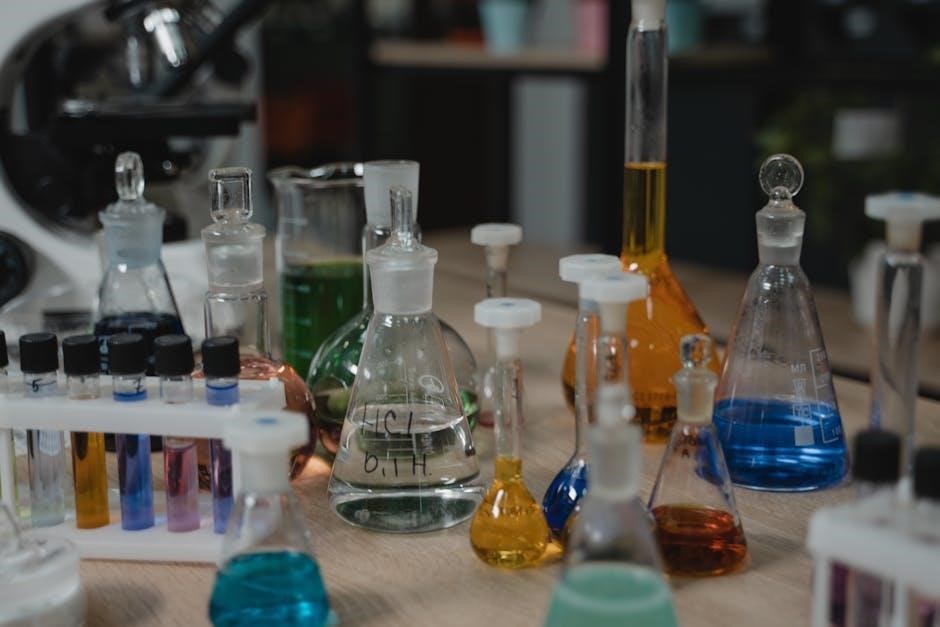
Understanding data analysis‚ error identification‚ and proper graph plotting are crucial. Don’t just memorize; visualize the experiments. Practicing past paper questions focusing on practicals will boost exam performance significantly.
Exam Technique and Time Management
Considering the CBSE Class 12 Chemistry exam (05/04/2026 12:55:21)‚ effective time management is key. Students should allocate time per question‚ prioritizing those with higher marks.
Carefully read each question before answering‚ and show all working for calculations. Utilize PDF revision notes for quick formula recall. Practice past papers under timed conditions to simulate the exam environment and build confidence.

Further Resources & Websites for GCSE Chemistry Revision
With the CBSE Class 12 Chemistry exam approaching (05/04/2026 12:55:21)‚ supplementing PDF revision notes with online resources is beneficial. Explore websites offering interactive quizzes and video tutorials.
Utilize platforms providing past paper solutions and mark schemes for focused practice. Remember to verify the credibility of online sources. Combining PDF study with diverse online tools maximizes exam preparation and understanding.