Toccata and Fugue in D Minor (BWV 565): A Comprehensive Guide
BWV 565 sheet music is readily available in PDF format from various online sources. MuseScore.com offers free downloads for organ, piano, and violin arrangements.
Musopen.org provides copyright-free scores, including a brass transcription. VirtualSheetMusic.com also offers resources for learning and accessing the piece.
These platforms cater to diverse instrumental preferences, making Bach’s masterpiece accessible to musicians of all levels.
Historical Context of BWV 565
The Toccata and Fugue in D Minor, BWV 565, exists within a fascinating, yet somewhat murky, historical context. While universally attributed to Johann Sebastian Bach, its precise origins and even authorship have been debated by musicologists for decades. The piece’s popularity surged long before the advent of easily accessible PDF sheet music, becoming a staple of organ repertoire in the 19th century.
However, scholarly investigation revealed stylistic inconsistencies with Bach’s established compositional techniques, leading some to question his direct involvement. Despite these debates, the work’s enduring appeal remains undeniable. The availability of BWV 565 in PDF format through platforms like MuseScore.com and Musopen.org has dramatically increased its accessibility, allowing performers and students worldwide to engage with this iconic piece.
Interestingly, the piece’s fame was largely fueled by its association with the gothic horror aesthetic, particularly through its use in film scores. The ease of obtaining PDF versions has further cemented its place in popular culture, ensuring its continued performance and study for generations to come. The historical narrative surrounding BWV 565 continues to evolve alongside its digital dissemination.
Johann Sebastian Bach: Composer Biography
Johann Sebastian Bach (1685-1750) stands as one of history’s most influential composers, a master of the Baroque period. Though the authorship of the Toccata and Fugue in D Minor, BWV 565 has been debated, understanding Bach’s life provides crucial context. He served as a church organist and composer for much of his career, holding positions in Arnstadt, Mühlhausen, and Leipzig.
Bach’s compositional output was vast and diverse, encompassing organ works, cantatas, concertos, and orchestral suites. His profound understanding of counterpoint and harmony is evident throughout his oeuvre. The widespread availability of his works in PDF format, including arrangements of BWV 565 on platforms like MuseScore.com, has democratized access to his genius.
Despite achieving less fame during his lifetime than some contemporaries, Bach’s music experienced a revival in the 19th century, championed by figures like Mendelssohn. Today, his compositions are cornerstones of the classical repertoire, readily studied and performed thanks to the convenience of digital scores and PDF downloads. His legacy continues to inspire musicians globally.
Origins and Authorship Debate
The authorship of the Toccata and Fugue in D Minor, BWV 565 remains a subject of scholarly debate. While traditionally attributed to Johann Sebastian Bach, questions arose in the 20th century, suggesting the work might not be entirely his composition. Some scholars propose it could be based on a work by Dieterich Buxtehude, a prominent organist of Bach’s time;

The debate centers on stylistic inconsistencies and the lack of early manuscripts definitively in Bach’s hand. Despite these uncertainties, the piece’s enduring popularity hasn’t diminished. The accessibility of BWV 565 in PDF format, readily available on sites like MuseScore.com, allows musicians to engage with the work regardless of authorship questions.
Regardless of its precise origins, the Toccata and Fugue’s dramatic flair and technical demands have secured its place in the organ repertoire. The availability of digital scores in PDF ensures its continued study and performance, fueling ongoing research into its complex history.
The Compositional Structure: Toccata vs. Fugue
The Toccata and Fugue in D Minor, BWV 565, showcases two distinct Baroque musical forms: the toccata and the fugue. The toccata, meaning “touched” in Italian, is a virtuosic, improvisatory-style piece designed to display the performer’s technical skill. It’s characterized by rapid passages, dramatic chords, and a free-flowing structure.

Conversely, the fugue is a highly structured contrapuntal composition based on a single melodic theme – the subject – which is imitated by different voices throughout the piece. The BWV 565’s fugue section demonstrates masterful counterpoint, building complexity through interwoven melodic lines.
Accessing the score in PDF format, available on platforms like MuseScore.com, reveals how Bach juxtaposes these contrasting forms. The dramatic toccata gives way to the intricate fugue, creating a compelling musical narrative. Studying the PDF allows musicians to analyze the structural interplay and appreciate the genius of the composition.
Detailed Analysis of the Toccata Section
The opening toccata of BWV 565 is immediately striking, dominated by dramatic, cascading arpeggios and powerful chords. These bold gestures, readily visible when examining a PDF score from sources like MuseScore.com, establish a sense of grandeur and intensity. The section isn’t built on a clear melodic theme, but rather on harmonic progressions and virtuosic display.
Analyzing the PDF reveals frequent use of pedal points – sustained notes in the bass – over which the hands weave elaborate figures. These pedal tones create harmonic tension and drive the music forward. The toccata’s structure is episodic, moving between contrasting sections of varying texture and dynamics.
The famous opening flourish, often recognized even by non-classical music listeners, is a prime example of Bach’s compositional brilliance. Studying the PDF allows musicians to dissect the complex fingerwork and harmonic language, appreciating the technical demands and expressive possibilities of this iconic section.
Exploring the Harmonic Language of the Toccata
The harmonic language of the toccata in BWV 565, clearly visible when studying a PDF score from platforms like Musopen.org or MuseScore.com, is characterized by bold chromaticism and unexpected modulations. Bach frequently employs diminished chords and suspensions, creating a sense of instability and dramatic tension.
The piece largely centers around D minor, but ventures into related keys, often abruptly, contributing to the toccata’s improvisatory feel. Analyzing the PDF reveals a masterful use of dissonance and resolution, building and releasing harmonic energy. The harmonic progressions aren’t always predictable, adding to the music’s expressive power.
Bach’s skillful voice leading, even within the complex harmonic framework, ensures clarity and coherence. Examining a detailed PDF allows musicians to trace the movement of individual voices and appreciate the underlying harmonic structure. The harmonic richness is a key element of the toccata’s enduring appeal.
The Fugue Subject and its Development
The fugue subject of BWV 565, readily observable in a PDF score sourced from MuseScore.com or similar sites, is a striking and memorable melodic phrase in D minor. Its concise, descending character immediately establishes the fugue’s somber mood. Studying the PDF reveals how Bach masterfully develops this subject through various contrapuntal techniques.
The subject appears in all voices – soprano, alto, tenor, and bass – often transposed to different keys. Bach employs stretto, where the subject is imitated closely, creating a dense and complex texture. Inversions and augmentations of the subject further enrich the fugue’s harmonic and melodic landscape. A detailed PDF allows tracing these transformations.
Episodes, sections without a complete statement of the subject, provide harmonic and rhythmic contrast. These episodes, visible in the PDF, prepare for subsequent entries of the subject, maintaining the fugue’s momentum. The subject’s relentless development is central to the fugue’s dramatic power.
Contrapuntal Techniques Employed in the Fugue
Analyzing a PDF score of BWV 565, easily found on platforms like MuseScore.com, reveals Bach’s exceptional command of counterpoint. The fugue showcases a masterful interplay of independent melodic lines, creating a rich and complex texture. Inversion, where the subject is presented upside down, is prominently featured, visible when examining the PDF notation.
Stretto, a technique where the subject is imitated in close succession, builds intense harmonic and rhythmic drive. Retrograde, presenting the subject backwards, adds another layer of complexity. A clear PDF allows tracing these contrapuntal devices. Canon, where one voice imitates another exactly, is subtly employed.
Furthermore, Bach utilizes diminution, shortening the subject’s rhythmic values, and augmentation, lengthening them. These variations, readily apparent in a detailed PDF, demonstrate his ingenuity. The skillful combination of these techniques results in a fugue of remarkable depth and intellectual rigor, solidifying its place in musical history.
BWV 565 for Organ: The Original Instrumentation
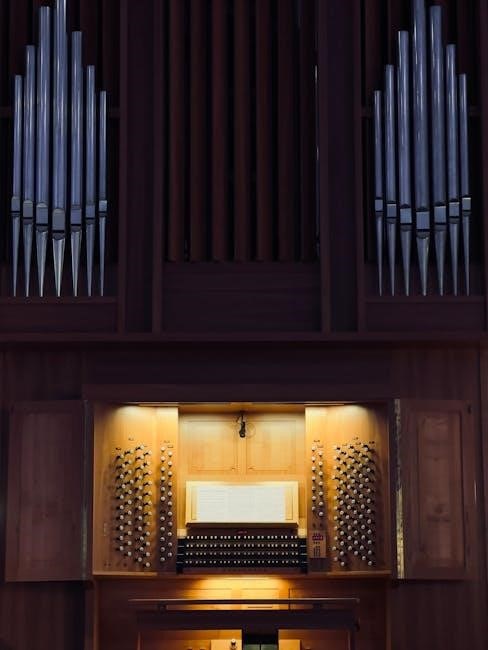
BWV 565 was conceived for the Baroque organ, a vastly different instrument than modern counterparts. Examining a PDF score sourced from Musopen.org or MuseScore.com reveals the piece’s demands on the organist and the instrument itself. The original instrumentation exploits the organ’s unique capabilities – multiple ranks of pipes, varying timbres, and dynamic contrasts.
The toccata’s dramatic opening relies on full organ registrations, showcasing the instrument’s power. The fugue, conversely, often employs clearer, more articulate stops. A detailed PDF allows observation of pedal markings, crucial for the organ’s bass lines. The use of manuals (keyboards) is integral to the work’s texture.
Understanding the Baroque organ’s construction is key to interpreting Bach’s intentions. While PDF transcriptions for piano or violin exist, they inevitably lose the specific colors and effects achievable on the original instrument. Accessing a high-quality PDF score is the first step towards appreciating the work’s organ-centric design.
Piano Adaptations of the Toccata and Fugue
Adapting BWV 565 for piano presents significant challenges, given the vast differences between the Baroque organ and the modern piano. Numerous piano arrangements are available as PDF downloads from sites like MuseScore.com and VirtualSheetMusic.com, each offering a unique interpretation.
These transcriptions often necessitate simplifying the complex textures and compensating for the piano’s inability to sustain notes indefinitely, a key feature of the organ. A PDF score reveals how arrangers tackle the pedal parts, typically assigning them to the left hand. The iconic toccata’s dramatic flourishes require considerable pianistic skill.
While a piano version cannot fully replicate the original’s grandeur, it allows wider accessibility to Bach’s masterpiece. Examining different PDF arrangements highlights the creative choices made by transcribers. These adaptations demonstrate the enduring appeal of BWV 565 across instrumental boundaries, even with inherent limitations.
Violin Arrangements and Their Challenges

Transcribing Bach’s Toccata and Fugue in D Minor (BWV 565) for solo violin is a formidable undertaking. The original, composed for organ, utilizes a full range of textures and sustained harmonies that are difficult to emulate on a single violin. PDF scores of these arrangements, readily found on platforms like MuseScore.com, reveal the ingenuity—and compromises—involved.
The primary challenge lies in representing the organ’s pedal tones and harmonic depth. Violinists must employ techniques like double stops and arpeggiation to suggest these elements, often sacrificing clarity. A PDF analysis shows how arrangers prioritize melodic lines while simplifying the harmonic structure.
Furthermore, the toccata’s rapid passages and the fugue’s contrapuntal complexity demand exceptional technical proficiency. Despite these hurdles, violin arrangements offer a compelling, albeit different, interpretation of BWV 565. Accessing a PDF version allows performers to study the adaptation’s intricacies and appreciate the arranger’s skill.
Other Instrumental Transcriptions (e.g., Brass)
Beyond piano and violin, Bach’s Toccata and Fugue in D Minor (BWV 565) has inspired transcriptions for diverse instruments, notably brass ensembles. These arrangements, often available as PDF downloads, showcase the piece’s adaptability and enduring appeal. Musopen.org, for instance, offers a free PDF of a brass transcription, demonstrating the work’s potential beyond the organ.
Brass arrangements capitalize on the instruments’ power and resonance to recreate the organ’s dramatic impact. However, challenges arise in translating the intricate counterpoint and harmonic richness. A PDF score reveals how arrangers distribute melodic lines and harmonic support across multiple brass voices.
These transcriptions often emphasize the piece’s rhythmic drive and majestic character. While differing from the original, they provide a fresh perspective on BWV 565. Obtaining a PDF allows musicians to explore these interpretations and appreciate the creative process of adapting a Baroque masterpiece for a modern ensemble.
Availability of Sheet Music in PDF Format
Finding PDF sheet music for Bach’s Toccata and Fugue in D Minor (BWV 565) is remarkably accessible in today’s digital landscape. Numerous online platforms offer free and paid versions, catering to various skill levels and instrumentation preferences. MuseScore.com stands out as a prominent resource, providing a wealth of PDF scores for organ, piano, and even violin arrangements.
These PDF files allow musicians to instantly download and print the music, eliminating the need for physical sheet music purchases. The availability extends beyond solo instrumentations; arrangements for ensembles are also frequently found in PDF format. Musopen.org contributes to this accessibility by offering copyright-free scores, including brass transcriptions, downloadable as PDFs.
VirtualSheetMusic.com further expands the options, providing resources for learning alongside the PDF scores. The widespread availability of BWV 565 in PDF format democratizes access to this iconic piece, enabling musicians worldwide to study and perform it.
MuseScore.com: A Source for Free Sheet Music
MuseScore.com is a leading platform for musicians seeking free sheet music, and Bach’s Toccata and Fugue in D Minor (BWV 565) is exceptionally well-represented within its extensive library. Users can readily download PDF versions of the score, arranged for a variety of instruments, all at no cost.
Currently, multiple arrangements of BWV 565 are available, specifically tailored for organ solo, piano solo, and even violin solo. These arrangements, uploaded by community members like Dave5400, hmscomp, ClassicMan, and Eduardo Ruiz R., offer diverse interpretations and skill-level adaptations. The platform’s user-friendly interface allows for easy searching and filtering, ensuring musicians can quickly locate the desired arrangement in PDF format.
The availability dates for these uploads – ranging from May 14th, 2024, to July 20th, 2024 – demonstrate the platform’s ongoing contribution to making this iconic piece accessible to a global audience. MuseScore.com provides a valuable resource for both learning and performing BWV 565.
VirtualSheetMusic.com: Resources for Learning
VirtualSheetMusic.com serves as a valuable resource for musicians aiming to learn and master Bach’s Toccata and Fugue in D Minor (BWV 565). While primarily a commercial platform, it offers access to sheet music, including PDF versions, designed to facilitate the learning process.
The website provides a dedicated page for the piano arrangement of BWV 565, offering a convenient starting point for pianists. Beyond simply providing the score in PDF format, VirtualSheetMusic.com often includes supplementary materials, such as practice tracks and performance guides, to aid in comprehension and execution.
Notably, the site is linked to a helpful YouTube tutorial – “Learn Toccata and Fugue in D minor BWV 565 by Bach ー Keyboard Practice Video” – offering visual and auditory guidance. This integration of multimedia resources enhances the learning experience, making BWV 565 more approachable for students of all levels. The platform aims to provide a comprehensive learning environment, extending beyond the traditional sheet music format.
Musopen.org: Copyright-Free Scores and Recordings
Musopen.org distinguishes itself as a treasure trove of copyright-free sheet music and recordings, offering a unique opportunity to access Bach’s Toccata and Fugue in D Minor (BWV 565) without licensing restrictions. For those seeking a PDF version of the score, Musopen provides a “Brassin Transcription” of BWV 565 available for free download.
This transcription is specifically tailored for brass instruments, presenting a fascinating alternative arrangement of the iconic work. Beyond the PDF score, Musopen also offers an accompanying MP3 recording, allowing musicians to familiarize themselves with the interpretation and phrasing of the piece.
The platform’s commitment to providing public domain materials makes it an invaluable resource for educators, performers, and enthusiasts alike. By offering both the score and a recording, Musopen facilitates a holistic learning experience, enabling users to engage with BWV 565 on multiple levels. It’s a fantastic resource for exploring alternative arrangements and interpretations of this timeless composition.
Learning Resources: YouTube Tutorials and Guides
YouTube serves as a dynamic platform brimming with tutorials and guides designed to assist musicians in mastering Bach’s Toccata and Fugue in D Minor (BWV 565). While direct PDF sheet music links aren’t always the primary focus of these videos, they often complement learning with visual aids and performance insights.
Many tutorials break down the complex passages of the Toccata and Fugue, offering fingerings, practice techniques, and interpretations. A valuable resource, linked through sites like VirtualSheetMusic.com, points to a “Keyboard Practice Video” designed to help learners navigate the piece’s challenges.
These videos are particularly beneficial for understanding the nuances of the composition and developing effective practice strategies. Search terms like “Bach Toccata and Fugue tutorial” yield a wealth of content, ranging from beginner-friendly introductions to advanced performance analyses. Supplementing PDF scores with these visual and auditory resources can significantly accelerate the learning process, offering a comprehensive approach to tackling this iconic work;
Keyboard Practice Techniques for BWV 565
Effective practice of Bach’s Toccata and Fugue in D Minor (BWV 565) demands a strategic approach, especially when utilizing PDF sheet music. Begin by isolating challenging sections – the rapid toccata passages and intricate fugal entries – for focused repetition. Slow practice is crucial; gradually increase tempo only when accuracy is maintained.
Hand separation is beneficial. Practice each hand independently before combining them, ensuring clarity and evenness. Pay close attention to articulation and dynamics, as these elements significantly impact the piece’s dramatic effect. Utilize a metronome to develop rhythmic precision, particularly in the fugue’s contrapuntal sections.
Furthermore, mental practice – visualizing the score and fingerings – can enhance learning. Regularly review the PDF score, analyzing harmonic progressions and structural elements. Break down complex passages into smaller, manageable units, and gradually integrate them into the larger context. Consistent, focused practice, guided by the score, is key to mastering this demanding work.
Common Performance Challenges and Solutions
Performing Bach’s Toccata and Fugue in D Minor (BWV 565) presents unique challenges, even with access to a PDF score. A primary difficulty lies in maintaining clarity and control during the toccata’s virtuosic passages. Solutions include diligent slow practice, focusing on evenness and articulation, and building finger strength.
The fugue’s contrapuntal texture demands precise voice leading and rhythmic independence. Careful study of the PDF, highlighting individual voices, aids comprehension. Another hurdle is managing the piece’s dramatic range, transitioning seamlessly between intense and lyrical sections.
Pedaling (on organ or piano) requires careful consideration to avoid muddiness. Finally, memorization can be challenging due to the piece’s length and complexity. Consistent practice with the score, followed by gradual memorization in sections, is recommended. Addressing these challenges through focused preparation ensures a compelling performance.
The Enduring Popularity and Cultural Impact

Bach’s Toccata and Fugue in D Minor (BWV 565) enjoys remarkable and enduring popularity, transcending classical music circles. Its dramatic opening and powerful presence have cemented its place in popular culture. The widespread availability of the score in PDF format has further fueled its accessibility and performance frequency.
The piece’s iconic status is evident in its frequent use in film soundtracks, notably in horror and suspense genres, capitalizing on its inherently dramatic qualities. It’s become a shorthand for “classical music” for many, even those unfamiliar with Bach’s broader oeuvre.
This cultural impact stems from its immediate emotional resonance and technical brilliance. The ease of accessing BWV 565 as a PDF allows aspiring musicians to engage with this masterpiece, perpetuating its legacy for generations. Its continued presence in media ensures its continued recognition and appreciation.

BWV 565 in Film and Popular Culture
Bach’s Toccata and Fugue in D Minor (BWV 565) has become a staple in film and television, often employed to evoke a sense of drama, mystery, or even the supernatural. Its dramatic flair lends itself perfectly to scenes requiring heightened tension. The accessibility of the piece, particularly through readily available PDF scores, has contributed to its frequent use.

Numerous films have featured the work, often in horror or thriller contexts, capitalizing on its association with gothic imagery and powerful emotions. Beyond film, the piece appears in commercials, television shows, and even video games, demonstrating its broad cultural reach.
The ease with which musicians can obtain a BWV 565 PDF allows for creative reinterpretations and arrangements, further expanding its presence in popular culture. This constant exposure ensures that Bach’s masterpiece continues to resonate with new audiences, solidifying its iconic status.